

Finding a split limb on a prized White Oak or a sagging branch on your favorite Cherry tree is a stressful moment for any homeowner. In Maryland, our landscape faces a unique gauntlet of weather from heavy winter ice loads to the violent “microburst” winds of summer thunderstorms.
When a limb cracks, your first instinct is likely: Can this be saved, or do I have to cut it down?
The short answer is yes, many split limbs can be saved. However, success depends on three things: the speed of your response, the size of the limb, and the method of repair.

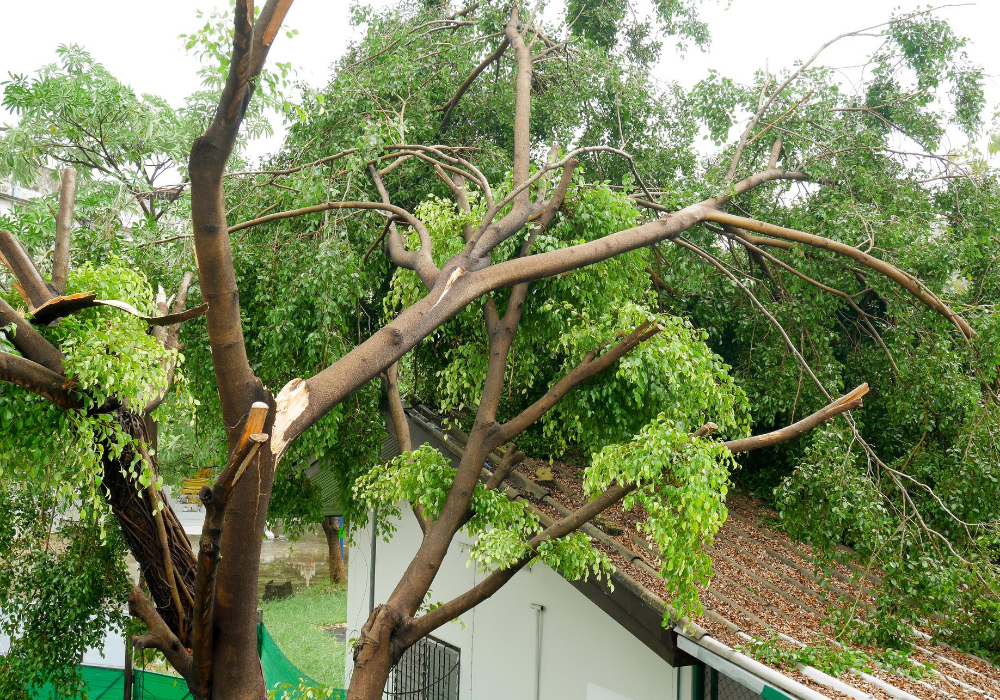
1. Assessing the Damage: Is Your Tree a Candidate for Repair?
Before you reach for the ladder, you must determine if the tree is structurally sound enough to survive a repair. At Nelson Tree Specialist, we use a specific set of criteria to evaluate storm-damaged trees in Maryland:
- The 50% Rule: If more than 50% of the tree’s crown (the leafy top) is damaged or gone, the tree will struggle to produce enough energy to heal. In these cases, removal is often the safer, more cost-effective choice.
- The “Leader” Health: The leader is the primary upward-growing trunk. If the split is in the main leader, the tree’s structural integrity is compromised. Side branches are much easier to save.
- Heartwood Exposure: Look at the “wound.” If the split is deep enough to reveal a large amount of the inner wood (the heartwood), the clock is ticking. Exposed heartwood is vulnerable to Maryland’s high humidity, which invites wood-rotting fungi and pests like carpenter ants.
2. Why “Just Taping It” Usually Fails
A common DIY mistake is wrapping a split limb in duct tape or rope and hoping for the best. To understand why this fails, you have to understand how a tree “heals.”
Trees don’t actually heal like human skin; they compartmentalize. When a split occurs, the tree’s vascular system (the cambium layer) is severed. This is the “nutrient highway” that moves water from the roots to the leaves.
If the split isn’t held together with immense, stable pressure, the wind will constantly “wiggle” the wound, breaking the delicate new cells the tree is trying to grow. Professional bracing provides the absolute stillness required for those tissues to fuse.
3. Professional Solutions: Cabling vs. Bracing
When a limb is too large for simple tape, our ISA Certified Arborists utilize structural hardware to save the tree.
Tree Bracing (For Major Splits)
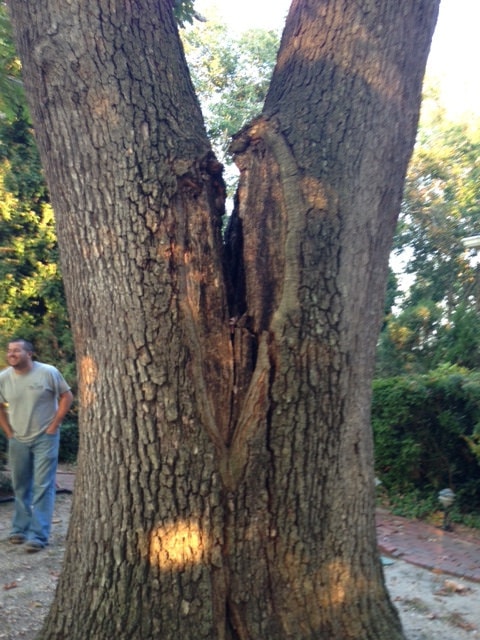
For large limbs or split trunks (often seen in “V-shaped” unions), we install steel threaded rods.
- How it works: We drill through the trunk and bolt the split sides together.
- The Result: This provides immediate compression, closing the gap and allowing the cambium layers to touch and eventually fuse.
Tree Cabling (For Heavy Canopies)
Cabling is a preventative and curative measure for trees with heavy, over-extended limbs.
- How it works: High-strength steel cables are installed in the upper third of the canopy.
The Result: The cable limits how much the branches can move during a storm, taking the mechanical “stress” off the split so the tree can focus on growth rather than survival.
4. Split Type & Survival Probability
Not all splits are created equal. Use this chart to gauge the urgency of your situation and the likelihood that our arborists can save the limb.
| Split Type | Description | Survival Probability | Urgency |
| Hairline Crack | A thin, shallow crack often caused by wind stress or weight. | High (90%+) | Monitor; schedule a professional check-up. |
| Partial Lateral Split | A side branch has split but is still securely attached at the base. | Moderate to High | High. Requires cabling to prevent a full break. |
| Main Leader Split | The primary trunk or “leader” has split down the middle (V-crotch). | Moderate | Critical. Needs immediate bracing to save the tree’s structure. |
| Complete Separation | The limb has fully detached or is hanging by a strip of bark. | Low | Emergency. Removal is usually the only safe option. |
5. Why Maryland Weather Makes Splits Urgent
In Maryland, we experience high humidity and rapid temperature swings.
- The Decay Factor: In our climate, wood-rotting fungi can enter an open tree wound in as little as 48 hours.
- The Ice Factor: A minor “hairline” split in October can become a catastrophic failure in January when ice accumulates on the branches, adding thousands of pounds of weight.
By addressing a split now, you prevent a total tree failure during the next “Nor’easter” or summer storm.

6. When to Call an ISA Certified Arborist
While you can handle a small snapped twig on a shrub, you should call a professional if:
- The limb is over 3 inches in diameter.
- The split is located above a roof, driveway, or power line.
- The tree is leaning more than it was before the split.
- You see sawdust or “frass” (insect waste) inside the crack.
Don’t Let a Split Limb Become a Fallen Hazard
A split branch is a ticking clock. Whether you are in Anne Arundel, Howard, Montgomery, Frederick, Carroll, or Prince George’s County, our team is ready to evaluate your trees and provide a plan to save them.
Get a Free Structural Evaluation or call Nelson Tree Specialist at 301-854-2218 today.